
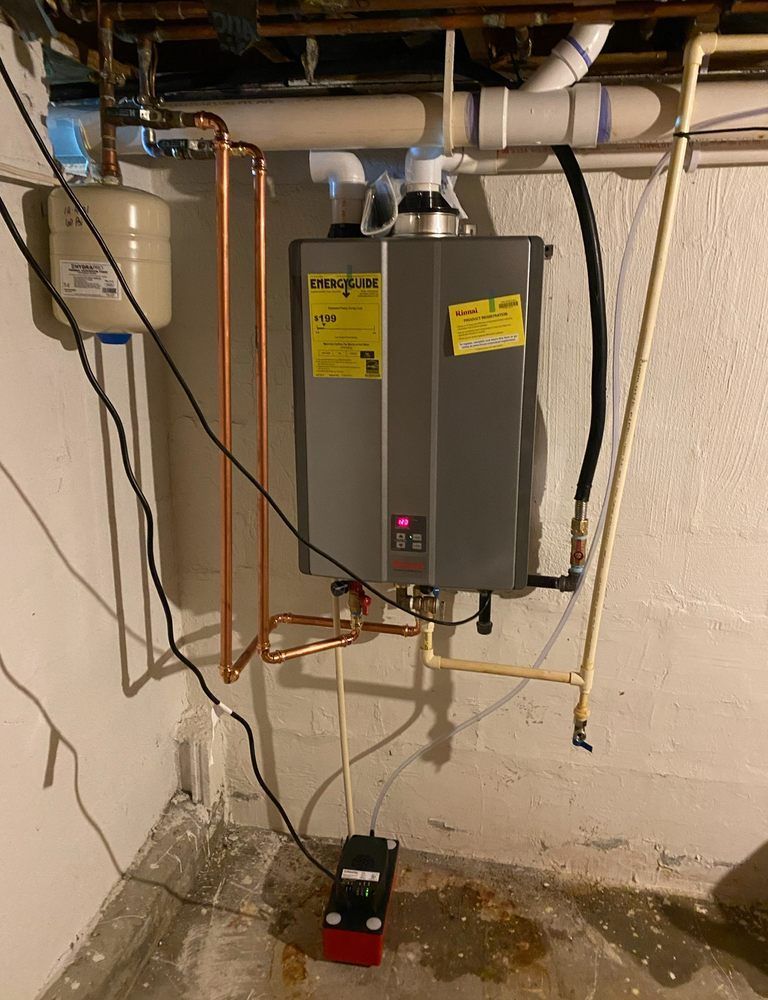
Continuous Hot Water Without Storage Limits
Tankless Water Heater Services in Buford for homes upgrading to on-demand heating or maintaining existing systems
Tankless systems heat water only when taps open rather than maintaining a standing supply, which eliminates standby energy loss and provides continuous hot water as long as flow stays within unit capacity. Installation, maintenance, repair, and replacement of tankless water heaters require understanding flow rate demands, gas line or electrical capacity, and proper sizing to match household usage patterns. Growing homeowner interest in space-saving plumbing upgrades has increased installations throughout Buford, particularly in homes where limited utility room space or high hot water demand make traditional tanks impractical.
Mulberry Plumbing Services evaluates whether your household's simultaneous fixture use falls within a tankless unit's flow rate capacity, because undersized systems will throttle temperature when multiple taps run at once. Proper sizing accounts for peak demand scenarios—showers running during dishwasher or laundry cycles—rather than average use. Installation includes gas line upgrades or dedicated electrical circuits when existing infrastructure can't support the unit's input requirements, plus venting modifications for combustion units.
Request tankless water heater service to evaluate system sizing and installation requirements for your home.
How Mineral Buildup Affects Tankless Performance
Annual maintenance reduces mineral buildup inside heat exchangers, where water passes through narrow channels at high velocity and elevated temperature. Scale accumulation in these passages restricts flow, reduces heat transfer efficiency, and triggers error codes for ignition failures or overheating. The maintenance process involves circulating descaling solution through the unit to dissolve mineral deposits before they harden enough to require heat exchanger replacement.
After maintenance clears mineral deposits, the system ignites consistently when taps open, delivers stable temperature without fluctuations during use, and provides the full rated flow capacity. You'll notice immediate hot water arrival at fixtures, maintained temperature even when additional taps open within capacity limits, and elimination of the cold water gaps that occur when clogged heat exchangers can't transfer heat fast enough.
Troubleshooting addresses ignition failures caused by gas valve issues or flame sensor contamination, flow problems traced to inlet screen blockages or failing flow sensors, and temperature inconsistencies linked to incorrect gas pressure or malfunctioning mixing valves. Some repairs involve replacing circuit boards, while others require mechanical component swaps that restore sensor accuracy and valve operation.
Answers to Frequent Service Questions
Homeowners considering or currently using tankless systems often ask these questions.
What happens during annual tankless maintenance?
Maintenance includes flushing the heat exchanger with descaling solution, cleaning inlet filters, testing ignition sequence and flame sensor operation, verifying proper venting, and checking gas pressure or electrical connections depending on unit type.
How do you determine the right size tankless unit for a home?
Sizing calculations account for the number of simultaneous fixtures, their individual flow rates, incoming water temperature in Buford, and desired output temperature, then match those demands to units rated for that total flow capacity at the required temperature rise.
Why does water temperature drop when multiple taps open?
Temperature drops indicate the unit has reached its maximum flow capacity and cannot heat additional volume to the set point, which means either the system is undersized for your usage or flow restrictors at fixtures need adjustment to stay within capacity.
When should a tankless unit be replaced instead of repaired?
Replacement makes sense when heat exchangers develop leaks from corrosion, when obsolete units lack available parts, or when repair costs approach the price of newer models with better efficiency and digital controls.
What energy savings do tankless systems actually provide?
Savings depend on household usage patterns, but eliminating standby heat loss typically reduces water heating costs by twenty to thirty percent compared to maintaining a full tank at temperature around the clock.
Mulberry Plumbing Services handles installation, annual maintenance, and repairs for tankless water heating systems. Arrange a consultation to discuss system sizing, efficiency benefits, and maintenance requirements specific to your household.